by Sally Cole
“Many people think that urban nature is nice to have, that it’s pretty or a bonus. But actually, it’s absolutely essential to our mental and physical health,”
— Professor Carly Ziter, urban landscape ecologist, Concordia University. [1]
Forest bathing is a recognized practice in Japan’s national health program. Known as shinrin-yoku, forest bathing is mindful time spent under the canopy of trees for health and wellbeing. Trees and plants release phytoncides, airborne chemicals that help them to ward off insects and fight disease and that also emit antimicrobial essential oils with medicinal properties. Forest bathing is a form of aromatherapy. Breathing forest air boosts the immune system, reduces blood pressure, lowers cortisol levels and improves concentration and memory. Walking in trees also reduces depression. Neuroscientists have found that metabolic activity in the subgenual prefrontal cortex — the part of the brain that is activated when a person is having sad thoughts – decreases by going for a walk in the woods. A walk on city streets does not have the same positive effect.
Dr. Qing Li, President of the Society of Forest Medicine in Japan and author of The Art and Science of Forest Bathing, describes forest bathing as a “preventative medicine.” His advice for a walk in trees is to “Make sure you have left your phone and camera behind. You are going to be walking aimlessly and slowly. You don’t need any devices. Let your body be your guide.”
In Britain “social prescribing” is a growing movement. The National Health Service (NHS) now recognizes a range of non-medicinal therapies and activities that doctors can prescribe for their patients’ wellbeing. These social prescriptions include gardening, volunteering and cooking. The Woodland Trust and other citizen’s groups are advocating for the NHS to add forest bathing to the list.
In Denmark, preschool children have thrived at forest schools since the 1950s. Richard Louv in his book Last Child in the Woods links the increasing numbers of children with health conditions such as attention deficit hyperactivity disorder (ADHD) to their limited access to nature in urban and even suburban contexts. Education amidst trees is now known to have huge psychological benefits for children and forest schools have become a global movement.

A peaceful walk among the trees at Westmount Summit.
Connecting with Trees
Healthy mature stands of trees are webs of connectivity. “Trees are social beings. The forest is a social network,” says German forester Peter Wohllben in his best-selling book The Hidden Life of Trees. Spending time with healthy trees is also participating in their lively social life.
Trees link to other trees through mycorrhizal networks. Fine, hair-like root tips of trees join together with microscopic fungal filaments to form the basic links of the network. Fungal threads link nearly every tree in a forest. Fungi consume about 30% of the sugar that trees photosynthesize from sunlight. Fuelled by “tree sugar,” fungi then scavenge and absorb nitrogen, phosphorus and other minerals from the soil and transfer these nutrients to trees through their roots. Mycorrhizal networks may supply plants and trees with up to 40% of the nitrogen and 50% of the water they need to survive. And trees may exchange with other trees between 10 and 40% of the carbon they store in their roots. As a tree ages, its mycorrhizal network develops more and more fungal connections and its roots grow deeper and deeper into the soil. Older and bigger trees with deep roots draw up water and circulate nutrients to younger or weaker seedlings. Interspecies networks of cooperation assist adaptation to environmental stresses and changing conditions.
Trees send carbon through mycorrhizal networks not only to trees that have grown through the same root system but also to “companion” species. For example, cedars and maples form networks that share nutrients as do hemlocks and firs. McGill University’s Morgan Arboretum preserves a healthy “maple sugar bush,” a network of trees comprised of ash, hickory and basswood growing among the sugar maples.
Trees have evolved to “help their neighbours” says Suzanne Simard, professor of forest ecology at the University of British Columbia and author of the bestseller, Finding the Mother Tree. When the biggest, oldest trees are cut down, the survival rate of younger trees is reduced. Trees live longer and reproduce more often in a healthy forest of stable underground mycorrhizal networks. Suzanne Simard describes an old-growth forest as an “ancient and intricate society” of trees, plant undergrowth, fungi and microbes that communicate with one another in symbiotic partnerships, the health of all depending on each.
Future Forest Bathing on Meadowbrook
Worldwide, citizens are urging their city councils and urban planners to pay attention to preserving trees and increasing accessible green spaces in urban areas. The proven positive effects of preserving trees and plants offer a simple and cost effective way to improve the quality of life and health of urban residents – and thus the social sustainability of cities themselves.
The city of Montreal plans to plant 500,000 trees by 2035 to increase its tree canopy to 25%. The prairie on Meadowbrook offers the city a special opportunity to build on existing stands of century-old silver maple, white elm and basswood trees and to re-naturalize this 57-hectare urban green space and increase biodiversity in the city.
Meadowbrook’s handsome mature trees are indigenous to the Great Lakes-St. Lawrence Forest Region, and offer ancient nesting sites to ducks, resting places for migrating birds and dens for squirrels, raccoons and other mammals. Other indigenous species such as burr oak, black cherry, ironwood, bitternut hickory and shagbark hickory grow along the railway tracks that bisect Meadowbrook. There are also several introduced species that are now naturalized in Canada including Norway maple, Siberian elm and crack willow. Re-naturalizing Meadowbrook would allow the planting and thriving of other tree species that were once native to the region including dogwood, vibernum, hawthorn, serviceberry, white elder and dogberry all of which produce small fruit to feed birds and other fauna.
AND, enhancing the tree networks and connectivity of Meadowbrook’s stands of mature trees will offer an accessible public space for Montreal residents to enjoy the healthful practice of forest bathing!
References:
[1] Hoag, Hannah. This is Your Brain on Trees. Globe and Mail. April 17, 2021
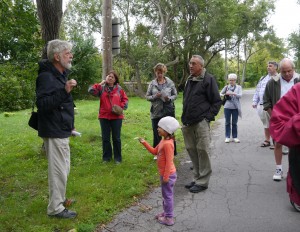 David pointed out invasive species, such as the Buckthorn tree, that crowd out native species and can be seen in large numbers in the area. They could be replaced with trees that are indigenous to the area, such as the Red Osier Dogwood, Eastern Cottonwood and Hawthorn. We learned about uses for some of the plants, such as Hawthorn berry juice and wild grape leaves, and even got to sample a few native Frost Grapes. The area includes tree stumps, and low-lying areas that become seasonal ponds, home to many insects and attracting migratory birds.